
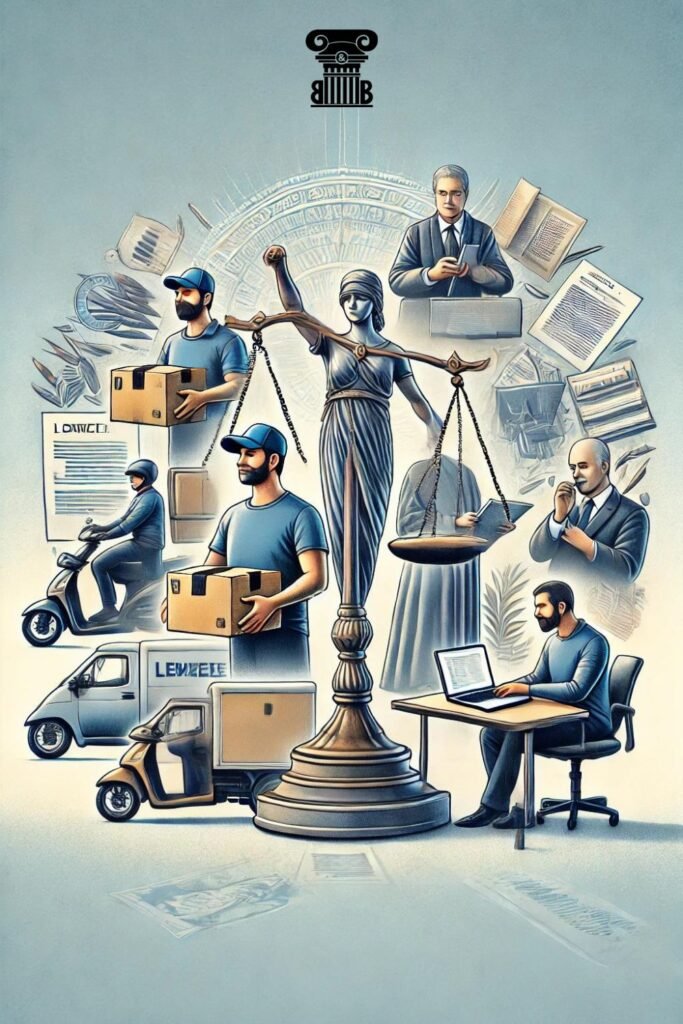
The Story
Amir left his office job two years ago and became a full-time gig worker. He drives for an e-hailing platform by day and delivers food on weekends. The flexibility was appealing—he could choose his own hours, spend more time with family, and earn based on effort.
But over time, cracks began to appear. His earnings fluctuated wildly depending on demand. When fuel prices spiked, his income shrank. When he was injured in a road accident, he discovered that he was not entitled to sick leave or hospitalisation benefits. The platform reminded him: “You are not our employee. You are an independent contractor.”
Amir felt invisible to the system. Unlike his friends in regular jobs, he had no EPF, no SOCSO, no annual leave, and no guarantee of minimum wages. He wondered: As a gig worker, am I invisible to Malaysian labour law? Does the law recognise my rights?
The Law
Gig work—also known as platform work, freelancing, or independent contracting—has grown rapidly in Malaysia, particularly in transport, delivery, digital services, and creative industries. But its legal status is still evolving.
1. Employment Act 1955 (Act 265)
- The Employment Act covers employees under a contract of service.
- Gig workers, however, usually sign a contract for service, meaning they are treated as independent contractors, not employees.
- As such, gig workers fall outside protections such as:
- Paid annual leave (Section 60E).
- Paid sick leave (Section 60F).
- Overtime pay (Section 60A).
- Maternity leave (Section 37).
- In short: gig workers are not automatically covered by the Employment Act.
2. Employees’ Social Security Act 1969 (SOCSO/Perkeso)
- Recognising this gap, Malaysia amended the law to allow gig workers to be covered under the Self-Employment Social Security Scheme (SKSPS), launched in 2017.
- This scheme provides protection for self-employed workers (especially e-hailing and delivery riders) in cases of accidents, injuries, or death at work.
- However, contributions are often voluntary, and many gig workers remain uninsured.
3. Employees Provident Fund Act 1991 (EPF)
- Gig workers are not automatically covered.
- However, they can voluntarily contribute to EPF under the i-Saraan scheme, where self-employed persons contribute and the government provides a small incentive.
- Again, this is optional, not mandatory.
4. Industrial Relations Act 1967
- This Act protects employees from unfair dismissal and regulates trade unions.
- Gig workers, being classified as independent contractors, are generally not covered. If a platform terminates their contract, they cannot bring an unfair dismissal claim to the Industrial Court.
5. Current Policy Moves
- The government has begun discussions on regulating gig work.
- In 2021, the Human Resources Ministry announced plans for a Portable Benefits Scheme for gig workers, allowing social security and retirement contributions to follow the worker across platforms.
- The Employment (Amendment) Act 2022 also introduced anti-discrimination provisions (Section 69F), hinting at future recognition of gig workers.
The Dignity Gap
Amir’s situation shows the dignity gap between formal employees and gig workers:
- Employees enjoy minimum wage, leave, EPF, SOCSO, and termination protections.
- Gig workers have flexibility but bear all risks—illness, accidents, low demand, or unfair treatment by platforms.
Gig workers often find themselves in a grey zone: not quite employees, yet not fully independent, since platforms control fares, ratings, and rules. This imbalance raises the question of whether gig workers are “invisible” under current labour law.

Lessons
For Gig Workers:
- Know your status. You are likely an independent contractor under a “contract for service.” This means you are not covered by the Employment Act.
- Protect yourself. Register for SOCSO’s Self-Employment Scheme (SKSPS) and consider voluntary EPF contributions under i-Saraan.
- Diversify income. Gig work is flexible but unstable. Having multiple income sources reduces risk.
- Join associations. Collective voices of gig workers are growing in Malaysia. They push for better legal recognition and benefits.
For Employers/Platforms:
- Acknowledge responsibility. Platforms benefit from gig workers’ labour. Treating them purely as “contractors” ignores the dependency relationship.
- Offer fair protections. Even without full employment contracts, companies can provide insurance, training, or allowances to safeguard workers.
- Avoid reputational risks. Public opinion is shifting toward fair treatment of gig workers. Companies that neglect dignity may face backlash.
For Government and HR Policymakers:
- Update legal frameworks. Labour law was designed for traditional employer–employee models. Gig work demands new rules.
- Consider hybrid protections. Other countries have introduced “dependent contractor” categories, giving gig workers some employee rights without full employment status.
- Expand social protection. Make SOCSO and EPF contributions more accessible, portable, and affordable for gig workers.
- Promote fairness. Enforce anti-discrimination laws to ensure gig workers are not unfairly penalised by arbitrary ratings or sudden account deactivations.
Conclusion
So, is Amir invisible to labour law as a gig worker? For now, partly yes.
- The Employment Act 1955 does not cover him because he is not an employee under a contract of service.
- The Industrial Relations Act 1967 does not protect him from unfair dismissal.
- But gig workers are not entirely without protection. They can register under SOCSO’s Self-Employment Scheme and make voluntary EPF contributions. The government is also working toward portable benefits and more inclusive regulation.
For gig workers, the lesson is to understand their legal status, take proactive steps for protection, and join collective efforts for reform. For platforms, the lesson is to balance flexibility with fairness—ensuring gig workers are not treated as disposable. For policymakers, the lesson is urgent: the future of work is here, and laws must evolve to ensure dignity for all, not just traditional employees.
Every worker—whether in a factory, office, or on a motorbike delivering food—dreams of dignity. Labour law may not yet fully deliver this for gig workers, but it is moving in that direction. Until then, awareness, self-protection, and advocacy remain the keys.
In short: Gig workers are not invisible. They are the future workforce. And the law must catch up to make sure their dignity is seen, valued, and protected.