
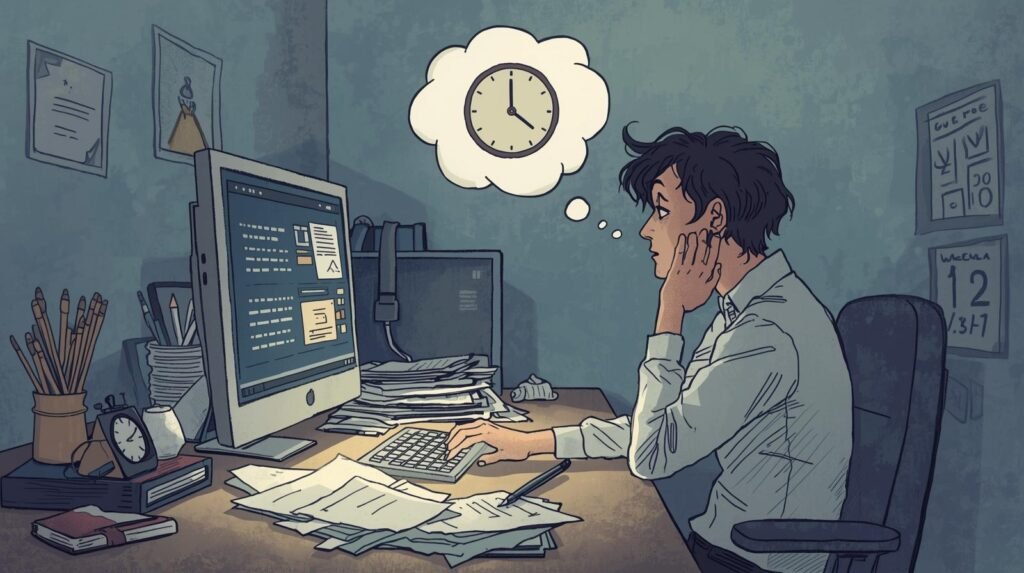
Arif had a routine that most of his colleagues noticed but rarely questioned. His official lunch break was from 1.00 p.m. to 2.00 p.m. Every day, he left the office promptly at one, enjoyed a good meal, sometimes met a friend, and then lingered over coffee. He only returned to work at 3.00 p.m., giving himself an extra hour.
Why? Because Arif believed it was only fair. His employment contract did not pay him overtime, yet he often stayed in the office until 9.00 or 10.00 p.m. to complete urgent tasks. He felt that the least he could do was to “take back” that unpaid hour during the day.
To him, it was balance. To the company, it was unnoticed—no one seemed to mind as long as the work was done. But the real problem arose when a colleague casually mentioned, “If something happens to you between 2.00 and 3.00 p.m., PERKESO may not cover you. You’re technically outside your work schedule.”
The comment struck Arif. He had never considered the legal implications. What if an accident happened on the road back to the office at 2.30 p.m.? Could he really be left unprotected?
The Act
Under the Employment Act 1955 (Act 265), working hours, rest days, and breaks are regulated. Section 60A requires that normal working hours must not exceed 45 hours a week, and employees are entitled to a rest break of at least 30 minutes after five consecutive hours of work. Employers typically set official lunch hours, and these become part of the agreed schedule of work.
The Social Security Act 1969 (SOCSO/Perkeso) further clarifies what counts as a workplace accident. Section 24 of the Act provides protection for accidents that occur “in the course of employment.” This includes accidents that happen while commuting directly between home and workplace or while performing tasks related to the job. However, protection may not apply if the employee is engaged in activities outside authorised working hours or outside the normal course of employment.
In Arif’s case, his official lunch break ends at 2.00 p.m. If he is injured during his “self-declared” extra hour, an employer or insurer may argue that he was not in the course of employment. That means he risks losing his right to claim benefits from PERKESO for that period.
Moreover, while Arif may feel justified for not claiming overtime, the law already entitles him to it. Section 60A(3) of the Employment Act provides that overtime beyond normal hours must be paid at 1.5 times the hourly rate on working days, and even higher on rest days and public holidays. By quietly compensating himself with a longer lunch break, Arif is essentially giving up his legal entitlement while exposing himself to risks.

The Lessons
For Employees:
- Extending lunch beyond the approved hour may seem harmless, but legally, it is not protected. If an accident occurs between 2.00 and 3.00 p.m., you may lose your PERKESO coverage.
- Working beyond official hours without claiming overtime is not a sacrifice the law expects from you. The Employment Act guarantees your right to OT pay. By not claiming, you are silently forfeiting money and protection that are lawfully yours.
- Instead of adjusting your own lunch hours, the proper course is to raise the issue of overtime with your HR department or to negotiate flexible working arrangements under Section 60P of the Act, which allows employees to apply for flexible work.
For Employers:
- Ignoring overtime is a breach of statutory obligation. Failure to pay OT may expose the company to penalties under Section 100 of the Act.
- Turning a blind eye to extended lunch breaks may appear convenient, but it creates liability risks. If an employee is injured outside the defined work schedule, disputes may arise about whether the accident is compensable.
- A better approach is to ensure overtime is tracked and paid fairly, or to introduce flexible working arrangements formally, so both the company and employee are legally protected.
Conclusion
Arif thought he was balancing the scales by taking an extra hour at lunch to compensate for the long nights he spent at the office. But in truth, he was exposing himself to unnecessary risks. By stepping outside his authorised schedule, he risked losing his protection under PERKESO, and by not claiming overtime, he denied himself a right guaranteed by law.
The law is clear: lunch breaks are fixed for a reason, and overtime must be compensated. Employees should not self-adjust working hours at the cost of their protection, and employers must not ignore overtime obligations.
Fairness does not come from bending the rules; it comes from respecting them. For employees, the lesson is to value your rights and raise concerns properly. For employers, the lesson is to comply with the law and treat overtime transparently. Only then can both sides work with peace of mind, knowing that time, health, and effort are protected—not only in practice but also under the law.